
Research summary report of A01
Particle-bed 3D-printing by selective cement activation: Sustainability, process enhancement and material models
[10.04.2026]
Meier, Niklas; researcher, niklas.meier@tu-braunschweig.de
Zetzener, Harald; leading researcher, h.zetzener@tu.brauschweig.de
Kwade, Arno; project leader, a.kwade@tu-braunschweig.de
all: TU Braunschweig, Institute for particle technology
The fundamental goal of project A01 is to understand material process interactions in particle-bed 3D printing by Selective Cement Activation (SCA). In SCA, a particle-bed consisting of fine aggregates and cement is applied layerwise. In between the layerwise application, a liquid is applied selectively on the upper layer of the particle-bed. Thereby, the cement hydration reaction is induced locally, and the particle-bed hardens at the selected areas, finally building up to a component. In the second funding period of this project, we focus on sustainability, process enhancement and material models.
Summary
Particle-bed binding processes, such as 3D concrete printing by Selective Cement Activation (SCA), are different compared to extrusion processes. In extrusion processes, all deposited material ends up in the printed part. On the contrary, in particle-bed binding processes for each layer, material is applied over the complete area of the building chamber (Figure 1, top). In a second step, the material is selectively bound for each layer (Figure 1, bottom). Thus, after binding the last layer, the printed component is surrounded by an unbound particle bed. Advantageously, the particle bed acts as support, so overhangs can be printed without additional effort, compared to extrusion processes. However, depending on the component geometry, the required material volume can be much higher compared to the component volume itself. The difference ends up as unbound particle-bed. To operate particle-bed binding processes environmentally sustainable, the unbound particle-bed must be reused in the next print(s) (cf. Figure 2). This is especially challenging for SCA as the particle bed is a mixture of fine aggregates, cement and admixture. The large difference in median particle size of aggregate (e.g. 300 µm) and cement (e.g. 9 µm) poses the risk for segregation. Due to the low particle size of the cement, dust can be generated during handling and is lost for the printing process. As cement reacts with water, the quality can degrade due to ambient moisture.
Current state of research short
To investigate potential material degradation in SCA, we conducted an experimental study. In this study, we used the same material for 10 consecutive passes through the SCA printer, printed specimens during the 1st, 5th and 10th passes and further collected samples of the non-activated material. During the prints, some material was bound in the specimens. To account for that, we started with more material than necessary for one print, and passed all of the material through the printer in each pass. This way, we could ensure that all material used in each print passed through the printer the same number of times. On the contrary, in normal use, the bound material would be replaced with fresh material for the next print (cf. Figure 2). Hence, our experimental procedure represents a worst-case scenario. Nonetheless, we could not detect a significant decrease in compressive strength of the specimen after the material mixture went through multiple printer passes. For some materials, the compressive strength even increased with multiple printer passes. We conclude that it is generally possible to reuse the unbound material in SCA, which is a necessity to use the process environmentally sustainable.
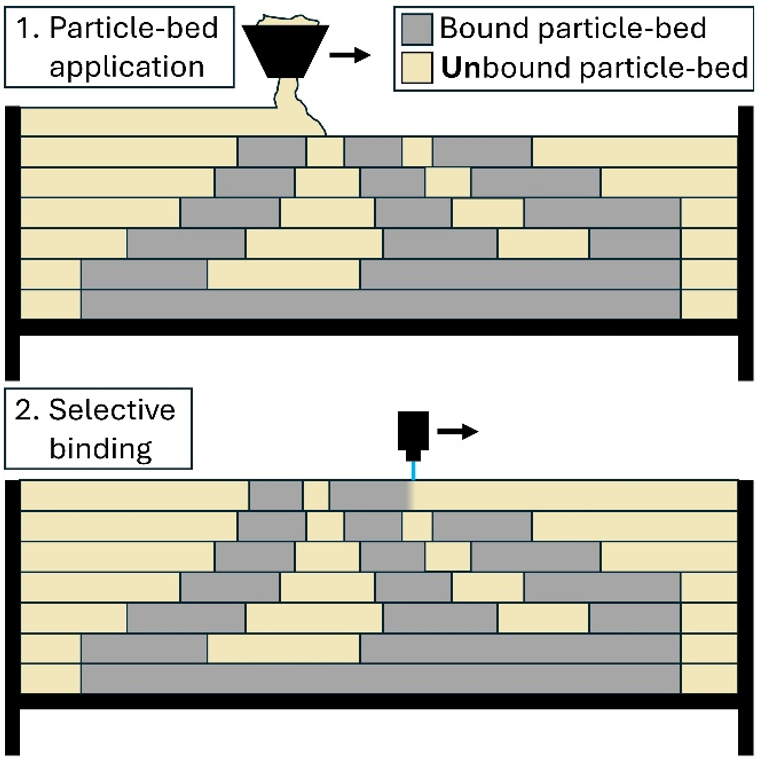
Figure 1: Schematics of the particle-bed application (top) and selective binding (bottom) of a particle-bed binding process, here SCA. / Credit: WG Kwade
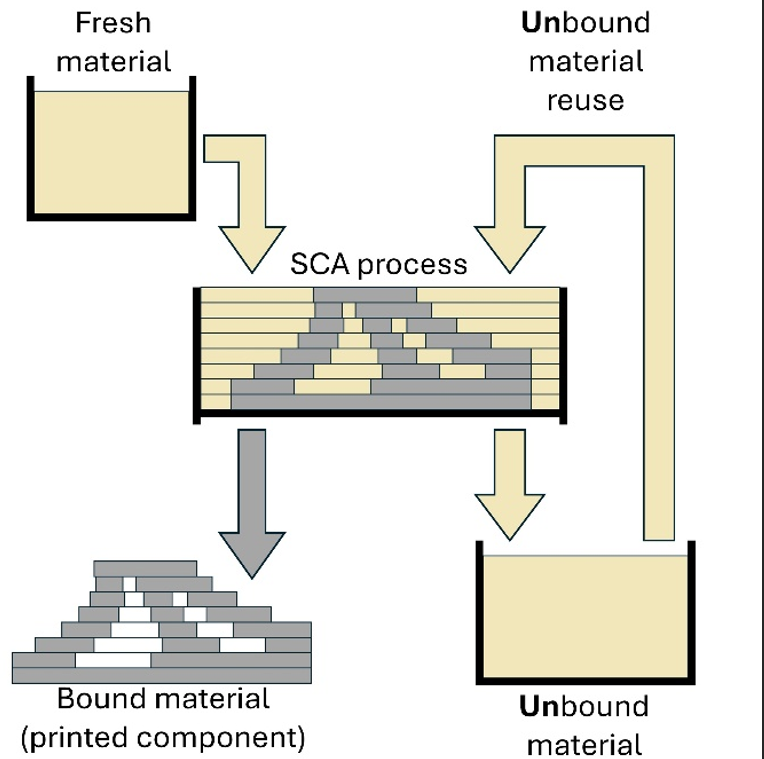
Figure 2: Material flow in 3D concrete printing by Selective Cement Activation (SCA) if the unbound material gets reused. / Credit: WG Kwade