
Has Publication?: Yes
M. Sc. Felix Riegger
is a research associate in the workgroup of Prof. Dr.-Ing. Michael F. Zäh. As an expert in WAAM, he is responsible for the simulation and temperature modelling of the process.
M. Sc. Tom Rothe
is investigating the usability of prefabricated fibre reinforcement produced in a robotic winding process for different AM methods. He’s developing an automated production process of the fibre reinforcement for the special needs of the project. This includes the investigation of the most suitable reinforcement geometry, the build-up of a dynamic winding machine and the integration of it into a robotic winding process.
Prof. Dr. Nicolas Roussel AMC-MERCATOR-FELLOW
AMC-Mercator-Fellow Prof. Dr. Nicolas Roussel is in charge of the research activities dealing with rheology and processing of construction materials at the Navier Laboratory, FRANCE. He is the founding editor of the RILEM technical letters journal, president of the RILEM association and has received in 2007 the Robert L'Hermite award for his work on rheology of fresh concrete. With a Thompson Reuters H-index of 54 and more than 8.000 citations, he is the author or co-author of more than 130 papers in scientific journals such as Cement and Concrete Research, Physical Review letters or Journal of Non-Newtonian Fluid Mechanics. His research focus spreads from concrete rheology and rheometry to the understanding of construction processing technologies. Thereby his work covers various technology readiness levels and includes mixing and dispersion, centrifugation and granulation, vibration and compaction, molding, spraying and coating along with automation in construction. In 2022, Nicolas Roussel was appointed as AMC-Mercator-Fellow by the TRR 277 AMC in honor of his contribution to the AMC. Within the context of its AMC cooperation, he recently contributed to a workshop on “Materials and Processes in Additive Manufacturing” at TUBS, having the opportunity to see and discuss the research results and outputs of several AMC PhD and post doc researchers. This intensive exchange has led to the planning of a number of joint and collective publications dealing with the rheology and thixotropy of cement-based materials. According to Nicolas Roussel, the cooperation with the AMC as AMC-Mercator-Fellow "offers the opportunity to directly interact with high-level PhD students also in the coming years and thus to foster the AMC's strategic topics for the European industry". As a result of the above interactions, Prof. Dirk Lowke and Prof. Nicolas Roussel are planning for the submission of Franco-German ANR/DFG research project.
M. Eng. Ronny Scharf-Wildenhain
is a research associate at the Chair of Welding Engineering at Chemnitz University of Technology. His focus is additive manufacturing with wire and arc (DED-Arc). He is particularly concerned with process control and the properties of additively manufactured components made of high-strength filler materials.
M. Ed. Bettina Saile
was a scientific researcher in A08, with experience in concrete extrusion as well as in selective binding of cement. She was responsible for the cross-project coordination and organization at the TUM AMC Lab and was supporting the different projects in their planning and execution of experiments.
Prof. Dr.-Ing. Patrick Schwerdtner
is superviser of project C06 and leads one of the Doc. researchers especially concerning the selection and assessment of parameters and the basic layout of the process analysis. His expertise is used to develop (new) process models and innovative delivery approaches in the later phase. He is also responsible for the overall coordination of project C06 and the projects belonging to different Work Programmes ( 1.1, 2.1 and 3.).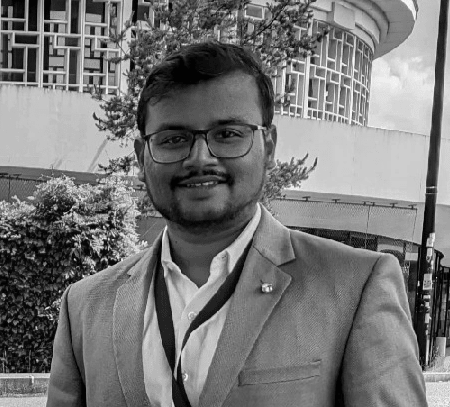
Dr. Shanmugaraj Senthilnathan
Dr. Shanmugaraj Senthilnathan is a postdoctoral researcher at the Chair of Materials and Methods in Digital Construction (M²DC) at the Technical University of Munich (TUM). His research focuses on the digital characterisation of fresh concrete properties using computer vision and multimodal sensing techniques. Within the AMC project, he is responsible for developing automated quality monitoring and closed-loop feedback systems for shotcrete 3D printing to improve geometric fidelity and process reliability. He further contributes to data analysis, scientific publications, and the advancement of digital construction methodologies.
M. Sc. Dorina Siebert
Doctoral researcher: carrying out scientific studies. She will play a decisive role in planning and conducting fatigue and fracture testing. The evaluation and interpretation of test results is also one of her tasks. Finally she undertakes statistical considerations, which are intended to serve as a basis for the development of design guidelines.”