
Research summary report of A04
Cooperative Additive Manufacturing processes based on Shotcrete 3D Printing
[13.03.2026]
Rudolph, Jennifer; doctoral researcher, j.rudolph@ibmb.tu-bs.de
Böhler, David; doctoral researcher, david.boehler@tum.de
Lowke, Dirk; project leader, lowke@tum.de
TU Braunschweig, Institute of Building Materials and Concrete Construction and Fire Safety (iBMB)
TU Munich, Department of Materials Engineering
Project A04 investigates cooperative Additive Manufacturing (AM) processes based on Shotcrete 3D Printing (SC3DP). The aim of this project is to fundamentally understand the SC3DP technology to manufacture sustainable, multi-objective optimised, reinforced concrete components with geometrically precise surface quality and improved building physics by functional integration.
Current state of research
Current SC3DP systems typically rely on single-nozzle configurations, which limit the process to the application of a single material. To enable more sophisticated material control, we are investigating two novel nozzle concepts: a near-nozzle active mixing setup and an adjustable dual-nozzle configuration.
This experimental series has been carried out in collaboration with WG Dröder and WG Kloft. The end effectors used for both nozzle concepts were conceived and fabricated by WG Dröder. We examined the mixing quality of two differently pigmented material streams, which were pumped through separate lines and deposited using both nozzle concepts under varying parameters. The printing strands were cut into slices and analyzed via greyscale imaging and density measurements. These analyses provide insight into the homogeneity and density distribution of the printed strands.
The results show that the active mixing nozzle produces a highly uniform blend of the two streams, largely independent of mixing intensity, making it well suited for two-component (2K) printing.
The dual-nozzle setup behaves differently: the homogeneity of the deposited material depends on the nozzles angel (α) and the distance of the jet intersection to the printing base (A). Figure 1 shows the dual-nozzle spraying process with two differently pigmented material streams, clearly visible as white and black jets intersecting during deposition. The configuration shown corresponds to a nozzle angle of α = 25° and a distance of 100 mm between the jet intersection point and the base.
Depending on the printing direction of the dual nozzle, it is also possible to influence lateral density variation and enable simultaneous side-by-side deposition, thereby opening new possibilities for multi-material structures (see Figure 2).
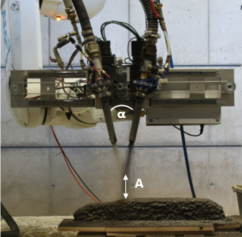 Figure 1: Printing with the dual-nozzle setup (α = 25°, A = 100 mm). Credit: TRR277: A04-WG Dröder/Lowke 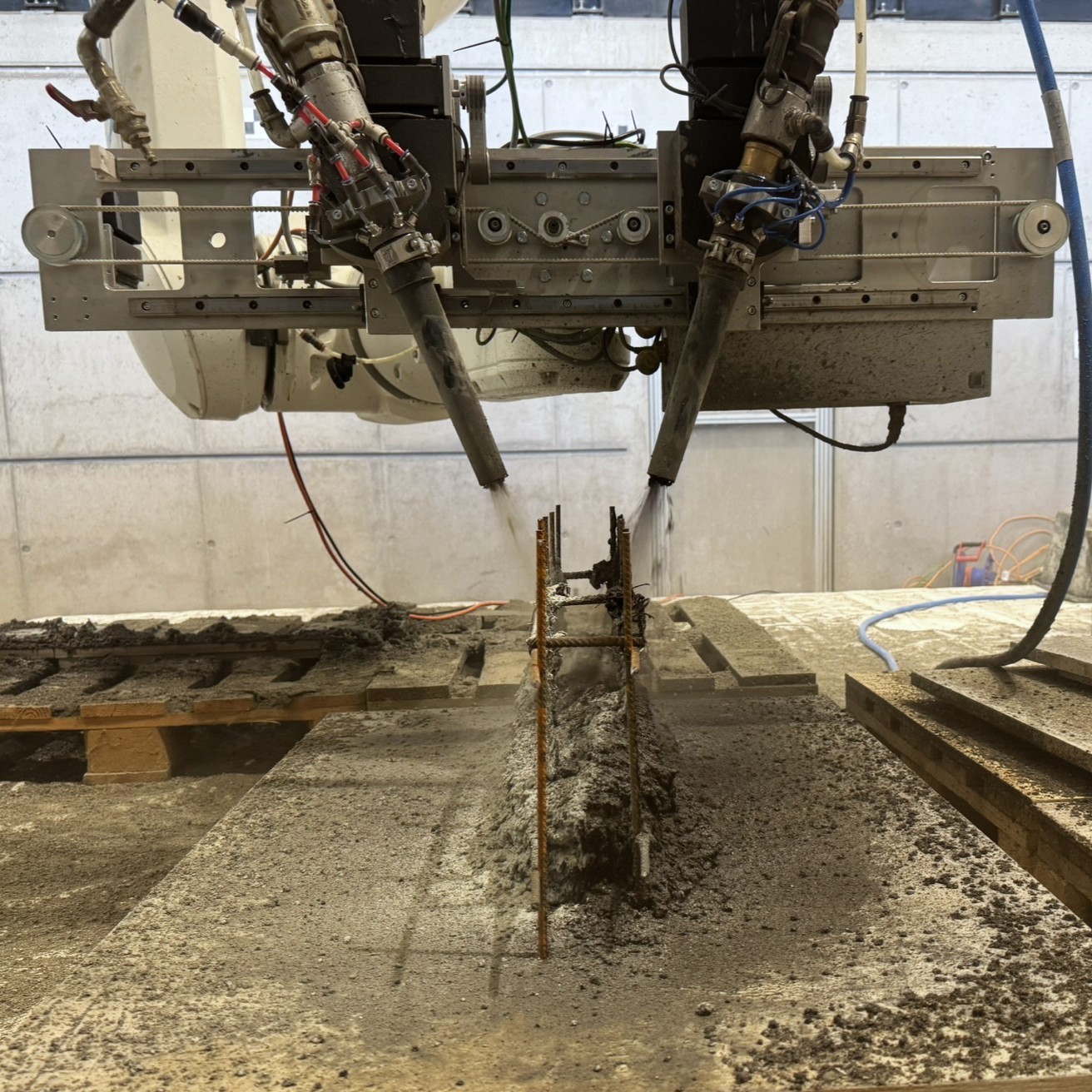 Figure 2: Multi-material printing with the dual-nozzle setup on prefabricated reinforcement. Credit: TRR277: A04-WG Dröder/Lowke |