Project C 02


3D Structural Puzzle – Numerical Multi Scale Shape and Topology Optimisation Methods to Additively Manufacture Optimal Structures from Optimised Pieces
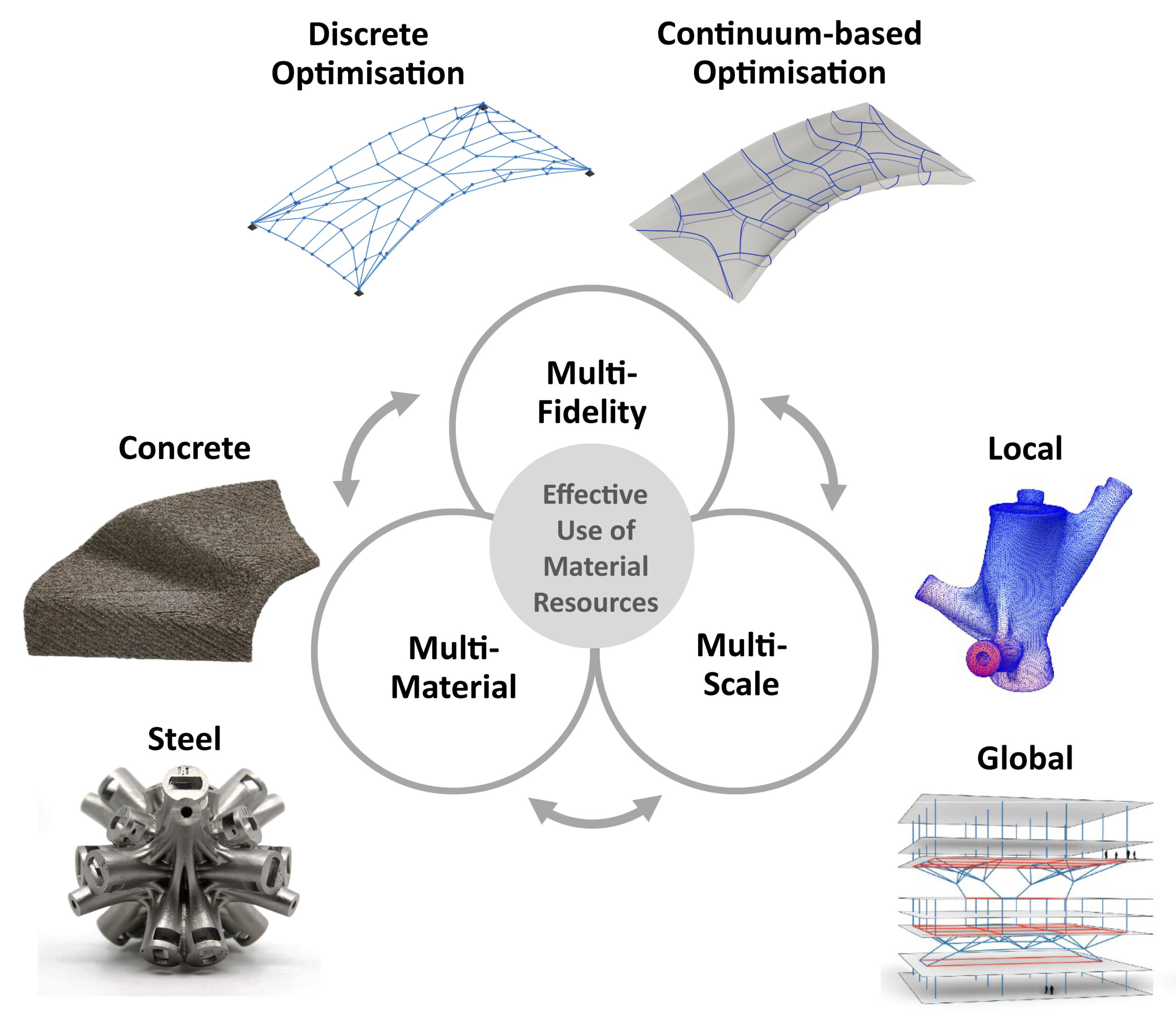
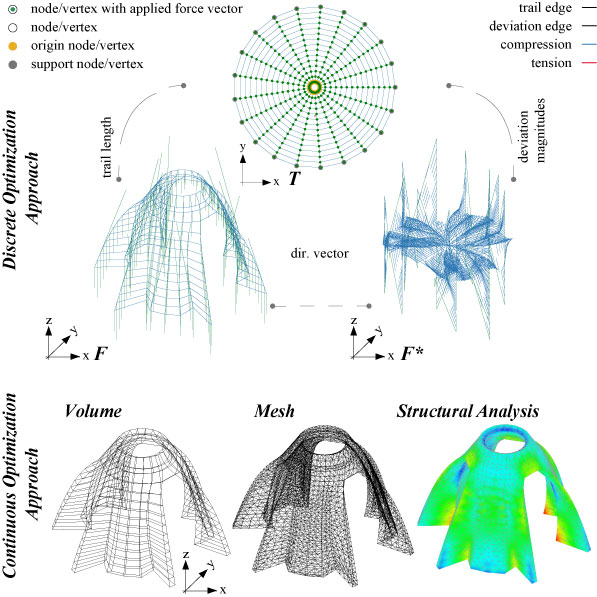
The CO2 Project addresses excessive material consumption in construction by developing a Holistic Design Framework (HDF) for Additive Manufacturing in Construction. Current building practices often treat architectural, structural, and fabrication aspects separately, leading to material inefficiency. To address this, the HDF integrates these aspects concurrently by combining two complementary strategies: a Discrete Optimization Approach (DOA) for low-fidelity structural exploration and a Continuum-Based Optimization Approach (COA) for high-fidelity structural refinement.
Objective
Formalization of a Holistic Design Framework (HDF) based on:
- Multi-fidelity: bi-directional coupling of Discrete Optimization Approach (DOA) and Continuum-based Optimization Approach (COA).
- Multi-scale: concurrent design of optimal structural forms (global scale) and segmentation into structural components (local scale).
- Multi-material: adaptability to different material models and opportunity for material grading.
- Integration of specific AM-process-related constraints and objectives.
- Development of dedicated interfaces to other AEC disciplines (building physics, building informatics, construction management, life-cycle
Approach
The proposed framework will lead to material savings by designing efficient structural forms that can be realized through additive manufacturing. These structures will fulfil requirements and objectives according to the respective design task by iterating the
following workflow:
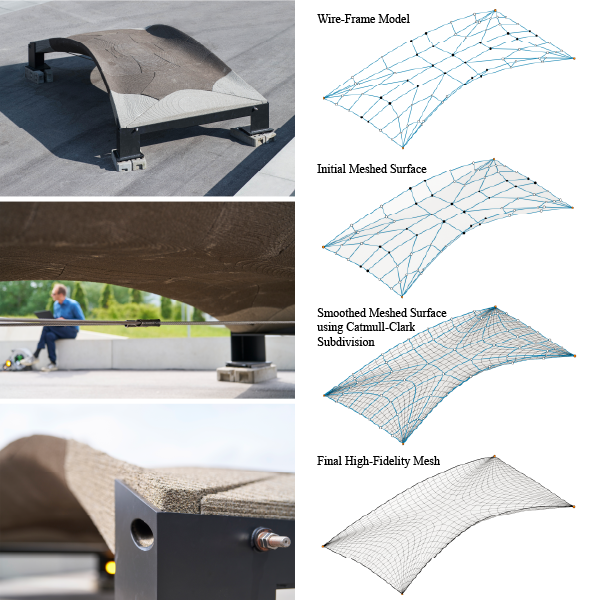
a. Exploration of the design space by form-finding structural forms in static equilibrium as discrete strut-and-tie networks (low-fidelity) using a Discrete Optimization Approach (DOA); generated structures
are optimized for additive manufacturing constraints and objectives based on topological and geometric design parameters.
b. Conversion of selected design solutions into continuous solid geometries with an associated material model for detailed design iterations (high-fidelity); topological, shape, and material optimization are carried out using a Continuum-based Optimization Approach (COA).
c. Back-mapping from COA to DOA for incorporating further insights gained by high-fidelity model optimization into the fast global design space explorations.
d. Segmentation of the optimal structural form (global scale) into components (local scale).
e. Integration of additional constraints and objectives derived from other disciplines, such as building physics and sustainable design.
Networking with other projects
Structural design plays a key role in additive manufacturing, both at the scale of entire structures and their individual components. Our methods are tailored to the specific requirements of various AM techniques, including particle-bed processes (e.g., SCA, SPI, SLM) and extrusion-based methods (e.g., WAAM, I3DCP). Close collaboration, especially with several A projects (e.g., A01, A09, A10) ensures these methods account for fabrication constraints. Additionally, we work with projects in focus area C to extend our framework toward integrated, multi-objective optimization—linking structural performance with building physics and sustainability (e.g., via C03). The Holistic Design Framework (HDF) developed in this project serves as a shared platform for testing and real-scale implementation across TRR 277.
Project leaders
D’Acunto, Pierluigi Prof. Dr. sc. ETH Zurich
Pierluigi D’Acunto is Assistant Professor of Structural Design and a Fellow at the Institute for Advanced Study at the Technical University of Munich. He holds a combined degree in Building Engineering-Architecture from the University of Pisa, a Master of Architecture from the Architectural Association in London, and a doctorate with distinction from ETH Zurich. His research explores geometry-based methods in structural design, computational approaches using equilibrium modeling, machine learning-driven form-finding, and fabrication-aware structural design strategies supported by advanced digital manufacturing technologies.
Project(s)
3D Structural Puzzle – Numerical Multi Scale Shape and Topology Optimisation Methods to Additively Manufacture Optimal Structures from Optimised Pieces
Wüchner, Roland Prof Dr.-Ing.
is Professor of Statics and Dynamics at the Technical University of Munich. He is project leader of C02 – 3D Structural Puzzle – Numerical Multiscale Shape and Topology Optimisation Methods for the Additive Manufacturing of Optimal Structures from Optimised Parts and further develops the existing methods of the Continuum-based Optimisation Approach (COA) within his research group.
Project(s)
3D Structural Puzzle – Numerical Multi Scale Shape and Topology Optimisation Methods to Additively Manufacture Optimal Structures from Optimised Pieces
Contributors
Chovghi, Frederic M. A.
Frederic Chovghi is a doctoral researcher at the Professorship of Structural Design at the Technical University of Munich (TUM). His primary research focuses on the development of fabrication-aware form-finding methods for extrusion 3D printing.
Project(s)
3D Structural Puzzle – Numerical Multi Scale Shape and Topology Optimisation Methods to Additively Manufacture Optimal Structures from Optimised Pieces
Dietrich, Sebastian M. Sc.
Sebastian Dietrich began his career with an apprenticeship as a formwork carpenter (2002-2005), later attending craftsman school and working in construction and architectural firms until 2010. He then studied International Civil Engineering at the University of Applied Sciences in Mainz and completed a Masters in Archineering at the Bauhaus University in Weimar, gaining experience in architecture…
Project(s)
3D Structural Puzzle – Numerical Multi Scale Shape and Topology Optimisation Methods to Additively Manufacture Optimal Structures from Optimised Pieces
Goldbach, Ann-Kathrin Dr.-Ing.
Dr.-Ing. Ann-Kathrin Goldbach is a researcher and educator in structural engineering. She is Deputy Director at the Chair of Structural Analysis at TUM. Her research focuses on parametric design, CAD-integrated analysis, isogeometric B-Rep analysis and lightweight and membrane structures.
Project(s)
3D Structural Puzzle – Numerical Multi Scale Shape and Topology Optimisation Methods to Additively Manufacture Optimal Structures from Optimised Pieces
Jakobs, Philipp M. Sc.
Philipp Jakobs is a doctoral candidate and research associate at the Chair of Structural Analysis at the TUM School of Engineering and Design, supervised by Prof. Dr. Roland Wüchner. His research is dedicated to advancing a Continuous Optimization Approach within the framework of the C02 project. With a strong background in computational mechanics and structural optimisation, his work complements…
Project(s)
3D Structural Puzzle – Numerical Multi Scale Shape and Topology Optimisation Methods to Additively Manufacture Optimal Structures from Optimised Pieces
Richter, Christiane M. Sc.
Christiane Richter is a research associate and doctoral candidate at the Professorship of Structural Design at the TUM School of Engineering and Design under the guidance of Prof. Dr. Pierluigi D’Acunto. With a solid foundation in structural engineering and expertise in concrete Additive Manufacturing, her primary focus lies in formulating a Holistic Design Framework (HDF). This framework integrat…
Project(s)
3D Structural Puzzle – Numerical Multi Scale Shape and Topology Optimisation Methods to Additively Manufacture Optimal Structures from Optimised Pieces
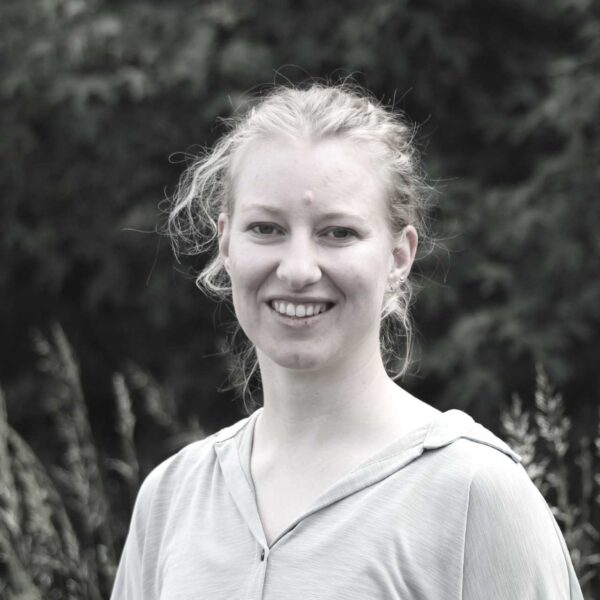
Wahl, Franziska M. Sc.
has a background in lightweight structures’ design and computational mechanics. Currently, she is a doctoral researcher at the Institute of Structural Analysis at TU Braunschweig with a focus on embedded finite element techniques and applications in multi-physics simulations and structural optimization. Within project C02, Franziska mainly contributes to the high-fidelity optimization approach.
Project(s)
3D Structural Puzzle – Numerical Multi Scale Shape and Topology Optimisation Methods to Additively Manufacture Optimal Structures from Optimised Pieces