Research summary report of A07
Wire and Arc Additive Manufacturing (WAAM) of Complex Individualized Steel Components
[05.06.2026]
Authors
Müggenburg, Marc; Doctoral Researcher, marc.mueggenburg@tu-braunschweig.de
Hinz, Felix; Doctoral Researcher, felix.hinz@tu-braunschweig.de
Unglaub, Julian; Project Leader, j.unglaub@tu-braunschweig.de
Institute of Steel Structures, Technische Universität Braunschweig
A07 focuses on developing load-specific, individual high-strength low-alloy steel DED-Arc components, understanding strengthening solutions for existing structures and designing various manufacturing strategies. The specific challenges of adaptive design and adaptive manufacturing of different scale components are addressed and a digital twin including data from the design and manufacturing process, surface geometry and component performance is elaborated. Physical and virtual component tests are carried out to gain comprehensive knowledge on load-carrying capacity, buckling behavior, the effect of imperfections and fatigue life performance. The project aims to advance DED-Arc application in construction by understanding, predicting and enhancing structural performance of DED-Arc steel.
Summary
Working group (WG) Unglaub is currently performing virtual tests of DED-Arc high-strength low-alloy steel components. In particular, the effect of the irregular as-built surface, inherent to the DED-Arc printing process, on the fatigue life is investigated with the goal to predict component performance.
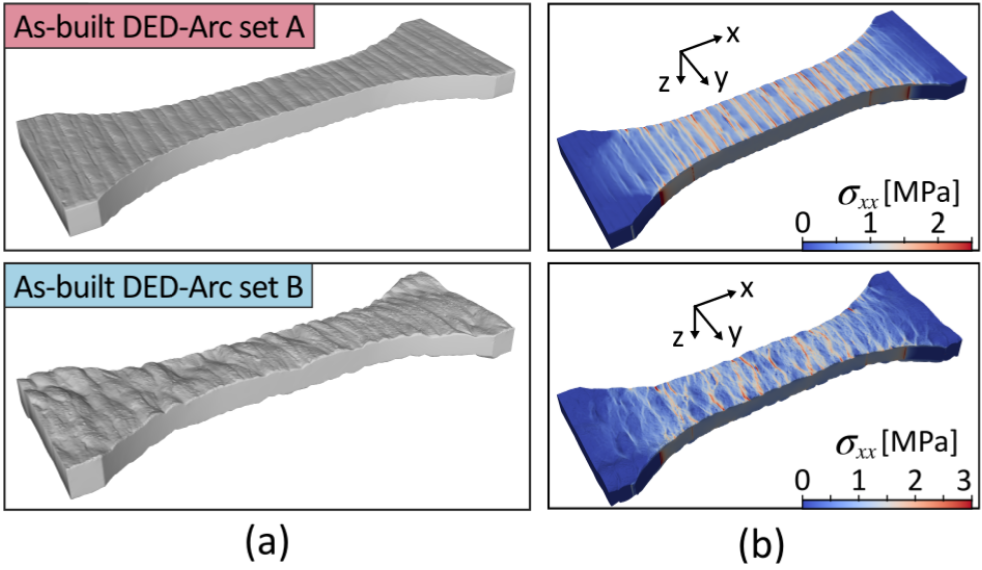
In the first step, as-built specimens with differing surface topography were 3D-scanned in collaboration with C06 / WG Gerke. Subsequently, in collaboration with C01 / WG Kollmannsberger, scan-based Finite Cell Simulations were set up and performed to derive stress distribution and, after further processing, obtain Stress Concentration Factors (SCF). Specimen geometry and resulting local stress distribution are shown in Fig. 1 for specimens with different as-built surface topography (e.g. from two different sets of DED-Arc manufacturing parameters).
The results highlight that the complex as-built surface geometry governs local stress distribution and leads to distinct stress concentrations at the layer boundaries. Specimens with more regular surface topography also exhibit more regular stress distribution while irregular surface topography leads to high local stress peaks. Additionally, physical fatigue testing of all specimens was performed to obtain the experimental fatigue life.
Current state of research
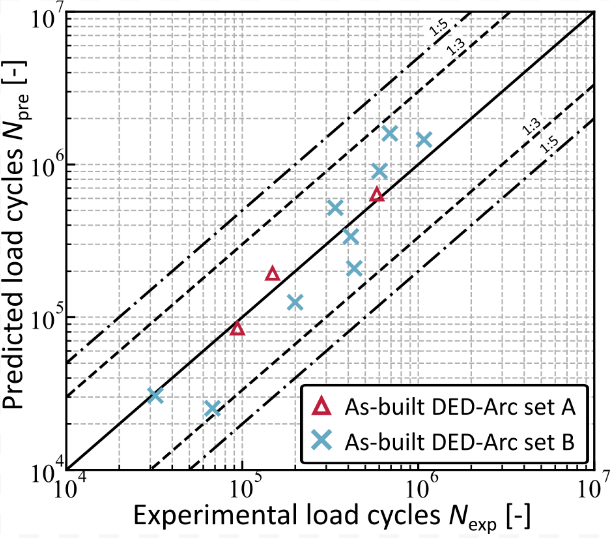
Based on the results from the virtual testing, two models for fatigue life prediction have been set up. As shown in Fig. 2, the fatigue life predictions from the regression-based model show good agreement to the results from experimental testing, thus highlighting that fatigue life can be predicted with similar accuracy across different DED-Arc specimens. These results highlight that DED-Arc load-carrying behavior and performance is intrinsically linked to the as-built surface and thus the manufacturing parameters and the overall approach in component design.