
Researchers at TU Braunschweig develop 3D-printed Spundwand Quartier: Federal Environment Minister presents prototype in Hamburg
Forschende der TU Braunschweig entwickeln in Kooperation mit dem TRR277 AMC ein 3D-gedrucktes Spundwand Quartier: Bundesumweltminister stellt Prototyp in Hamburg vor
Februar 2026 – innovatives Umweltprojekt aus der Forschung der Technischen Universität Braunschweig wurde letzte Woche in Hamburg offiziell vorgestellt: Das sogenannte SpundwandQuartier wurde von Bundesumweltminister Carsten Schneider sowie Hamburgs Zweiter Bürgermeisterin Katharina Fegebank präsentiert und bepflanzt. Unterstützt wurde die Entwicklung von der Stiftung Lebensraum Elbe im Rahmen des Projekts „Hamburg – Deine Flussnatur“.
Das SpundwandQuartier ist eine innovative, 3D-gedruckte Habitatstruktur, die bestehende Spundwände ökologisch aufwertet, ohne die tragende Infrastruktur maßgeblich zu verändern. Entwickelt wurde der erste Prototyp im Forschungsprojekt „Future Urban Coastlines“ in zusammenarbeit mit dem Teilprojekt Integrated Additive Manufacturing Processes for Reinforced Shotcrete 3D Printing (SC3DP) Elements with Precise Surface Quality des Sonderforschunsgbereischs TRR 277 Additive Manufacturing in Construction an der TU Braunschweig.
Neue Perspektive auf urbane Ufer
Viele urbane Gewässer sind durch glatte, technisch optimierte Spundwände geprägt. Sie stabilisieren Böschungen, bieten aber kaum Lebensraum für Pflanzen und Tiere. Hier setzen die Forschenden rund um den Nachwuchsforschergruppe "Future Urban Coastlines" Dr.-Ing. C. Gabriel David, die Institutsleiter Prof. Harald Kloft und Prof. Nils Goseberg an: Mit Hilfe von 3D-Druck im Betonbau (Shotcrete 3D Printing) entwickeln sie modulare Bausteine, die in bestehende Spundwände eingehängt werden können. So entstehen neue Strukturen im und am Wasser, ohne aufwendige Umbauten oder Eingriffe in die Statik. Die Idee dahinter ist einfach und wirkungsvoll: Bestehende Infrastruktur nicht ersetzen, sondern intelligent ergänzen.
Forschung mit direktem Nutzen für Umwelt und Städte
Unterhalb der Wasseroberfläche schaffen die 3D-gedruckten Module differenzierte Oberflächen, Nischen und Strömungsräume, in denen sich Biofilme, Algen und wirbellose Tiere ansiedeln können. Oberhalb der Wasserlinie bieten bepflanzbare Elemente Raum für überflutungstolerante Pflanzen. Damit verbindet das Projekt Bauingenieurwesen, digitale Fertigung des Sonderforschungsbereichs AMC TRR 277 und Ökosystemforschung, um urbane Gewässer ökologisch aufzuwerten.
Beitrag zu europäischen Umweltzielen
Das SpundwandQuartier unterstützt die Ziele der EU-Wasserrahmenrichtlinie und der EU- Biodiversitätsstrategie. Gleichzeitig zeigt das Projekt, wie innovative Bau- und Fertigungstechnologien konkret zum Umwelt- und Klimaschutz beitragen können.
Was als Forschungsprototyp begann, soll perspektivisch als übertragbares Modell zur ökologischen Nachrüstung urbaner Gewässer dienen.
Projektteam der TU Braunschweig
Christine Schottmüller (Institut für Geoökologie)
Robin Dörrie (Institut für Tragwerksentwurf/TRR277 AMC)
Jeldrik Mainka (Institut für Tragwerksentwurf /TRR277 AMC)
Natasche Holl (Institut für Geoökologie) Yamen Abou Abdallah (Institut für Tragwerksentwurf)
Gabriel David (Leichtweiß-Institut für Wasserbau)
Jennifer Rudolph (Institut für Baustoffe, Massivbau und Brandschutz/ TRR277 AMC)
Nils Goseberg (Leichtweiß-Institut für Wasserbau)
Harald Kloft (Institut für Tragwerksentwurf/TRR277 AMC)
Boris Schröder-Esselbach (Institut für Geoökologie)
Researchers at TU Braunschweig develop 3D-printed Spundwand Quartier: Federal Environment Minister presents prototype in Hamburg
February 2026 – An innovative environmental project from Technische Universität Braunschweig was officially presented in Hamburg last week. The so-called SpundwandQuartier was introduced and planted by Federal Environment Minister Carsten Schneider and Hamburg’s Second Mayor Katharina Fegebank. The development was supported by the Stiftung Lebensraum Elbe within the framework of the project “Hamburg – Deine Flussnatur.”
The SpundwandQuartier is an innovative, 3D-printed habitat structure designed to ecologically enhance existing sheet pile walls without significantly altering their load-bearing infrastructure. The first prototype was developed within the research project Future Urban Coastlines at TU Braunschweig.
A new perspective on urban waterfronts
Many urban waterways are characterized by smooth, technically optimized sheet pile walls. While they stabilize embankments, they provide little habitat for plants and animals. Researchers led by institute directors Prof. Harald Kloft and Prof. Nils Goseberg address this challenge using Shotcrete 3D Printing (SC3DP). They have developed modular elements that can be integrated into existing sheet pile walls, creating new structures both below and above the waterline, without extensive reconstruction or structural intervention.
The idea is both simple and effective: not to replace existing infrastructure, but to intelligently upgrade it.
Research with direct benefits for cities and the environment
Below the water surface, the 3D-printed modules create differentiated surfaces, niches, and flow conditions that encourage the settlement of biofilms, algae, and invertebrates. Above the waterline, plantable elements provide space for flood-tolerant vegetation.
The project combines structural engineering, digital fabrication within the Collaborative Research Centre AMC TRR 277, and ecosystem research to enhance urban waterways ecologically.
Contributing to European environmental goals
The SpundwandQuartier supports the objectives of the EU Water Framework Directive and the EU Biodiversity Strategy. At the same time, the project demonstrates how innovative construction and manufacturing technologies can make tangible contributions to environmental protection and climate resilience. What began as a research prototype is intended to evolve into a transferable model for the ecological retrofitting of urban waterways.
TU Braunschweig Project Team
Christine Schottmüller (Institute of Geoecology)
Robin Dörrie (Institute of Structural Design)
Jeldrik Mainka (Institute of Structural Design)
Natasche Holl (Institute of Geoecology)
Yamen Abou Abdallah (Institute of Structural Design)
Gabriel David (Leichtweiß Institute for Hydraulic Engineering)
Jennifer Rudolph (Institute for Building Materials, Concrete Construction and Fire Safety)
Nils Goseberg (Leichtweiß Institute for Hydraulic Engineering)
Harald Kloft (Institute of Structural Design)
Boris Schröder-Esselbach (Institute of Geoecology)
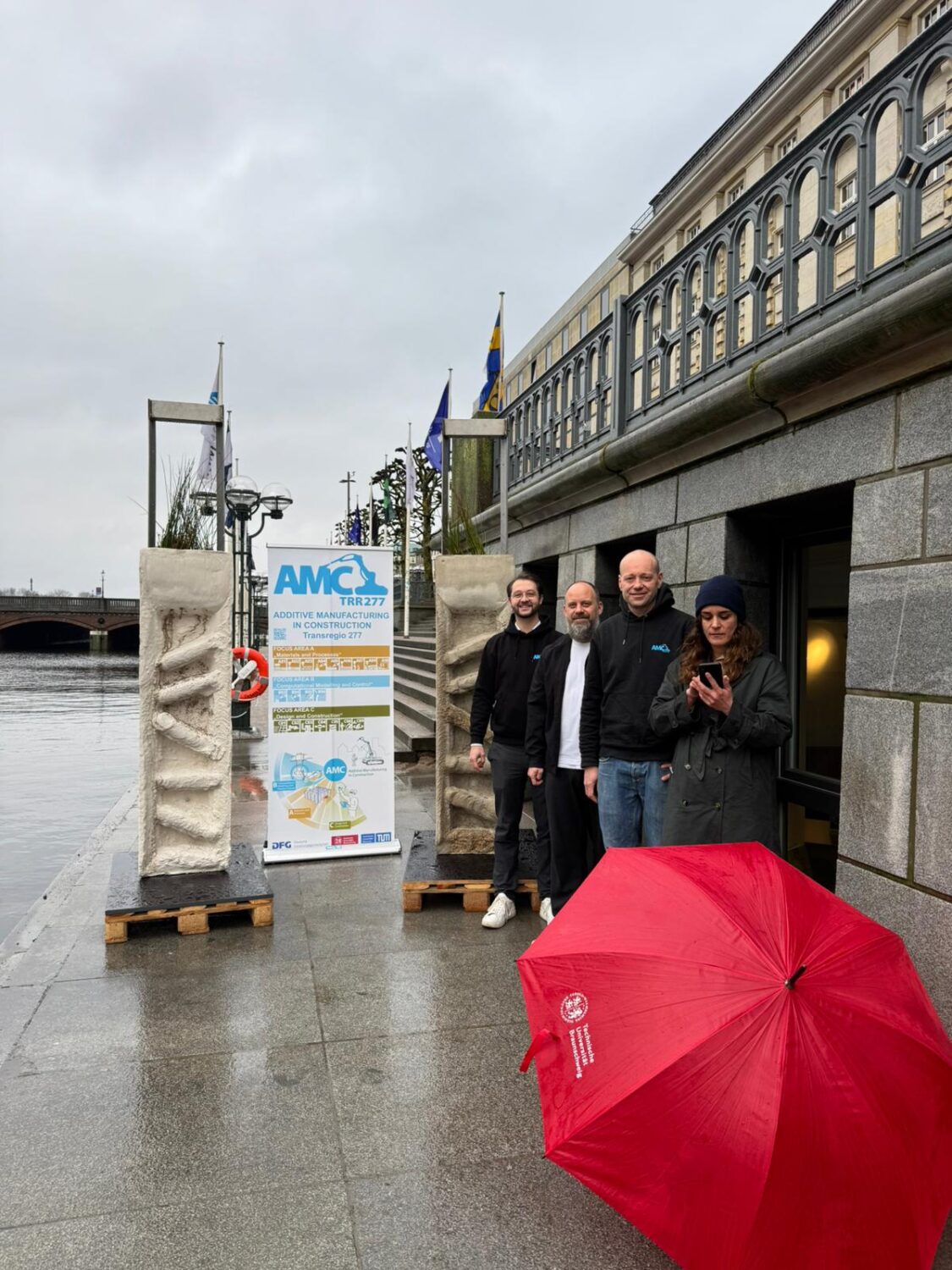
Forschende der TU Braunschweig mit dem Prototypen “Spundwand Quartiere” v.n.l.r. Robin Dörrie, David Gabriel, Jeldrik Mainka und Christine Schottmüller
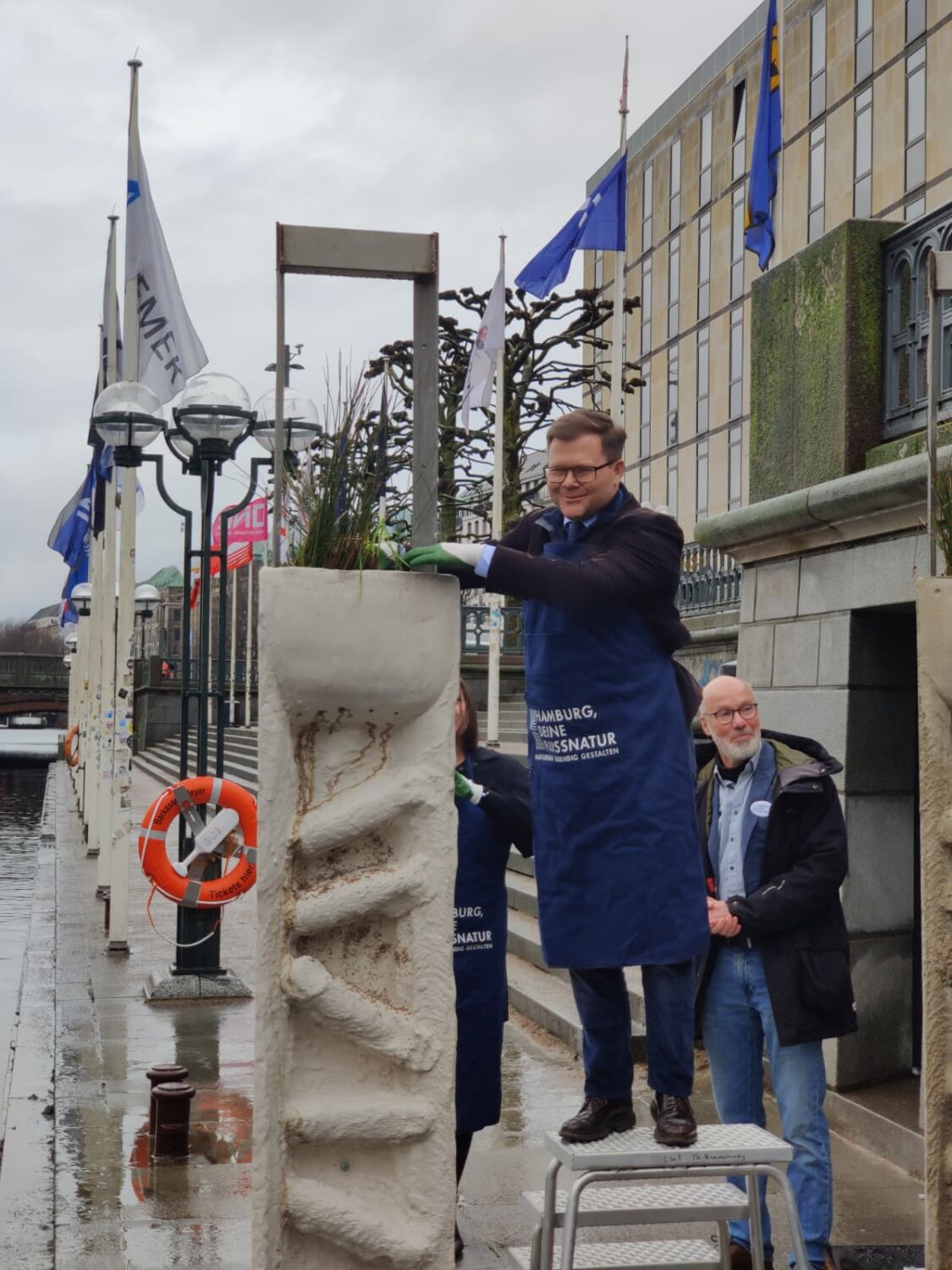
Bundesumweltminister Carsten Schneider beim Bepflanzen der Spundwand Quartiere
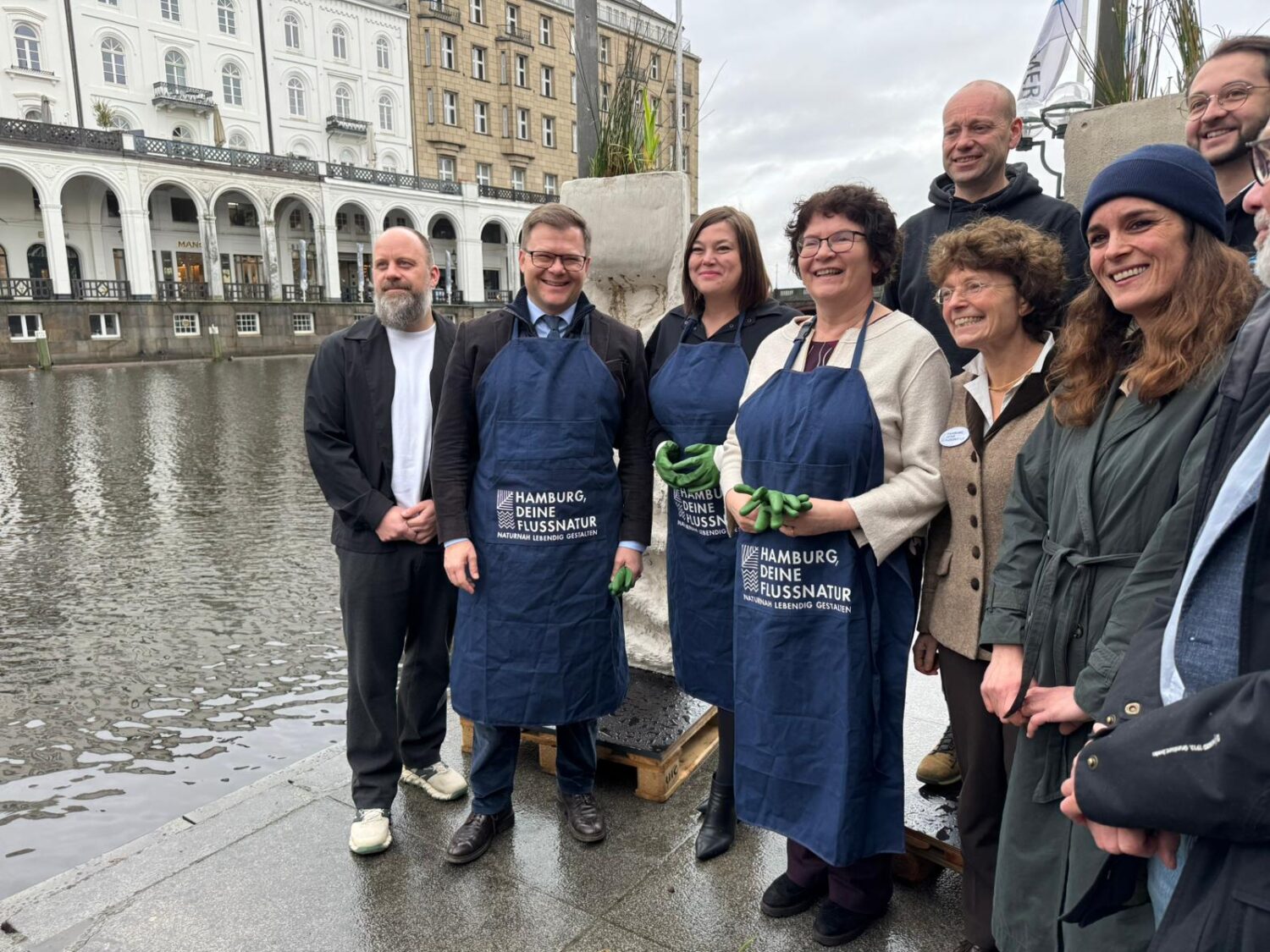
Einweihung der neuen Spundwand Quartiere mit: v.l.n.r. David Gabriel, TUBS; Carsten Schneider, Bundesumweltminister; Katharina Fegebank, Hamburgs Zweiter Bürgermeisterin; Sabine Riewenherm, Präsidentin Bundesamt für Naturschutz; Elisabeth Klocke, Vorstand Stiftung Lebensraum Elbe; Christine Schottmüller, TUBS / hinten: Jeldrik Mainka und Robin Dörrie beide TUBS